How to Actually Adjust Your Circadian Rhythm Around Daylight Saving Time
Quick Answer: Shifting your sleep and light exposure schedule by 15-20 minutes per day for several days before the actual time change, rather than adjusting all at once, gives your circadian rhythm a gentler transition and meaningfully reduces the several days of grogginess most people experience.
A single hour doesn’t sound like much, but daylight saving time reliably throws off sleep quality for days afterward — because your circadian rhythm doesn’t actually care what the clock says, it cares about light.

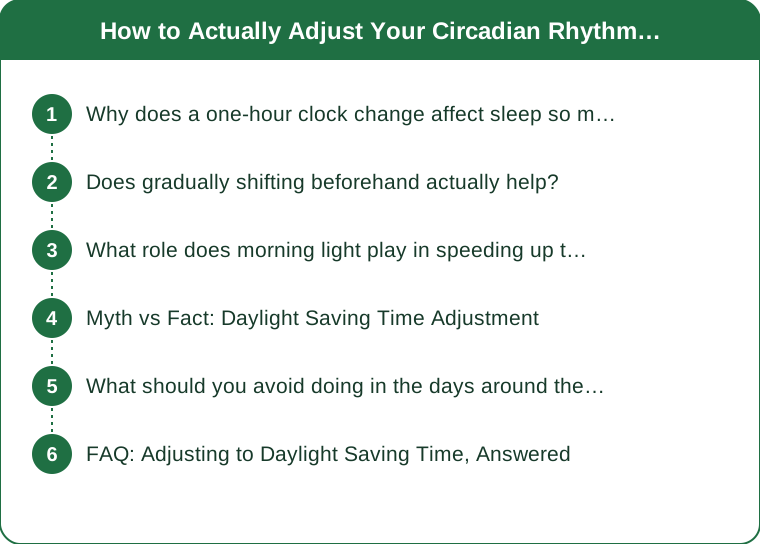
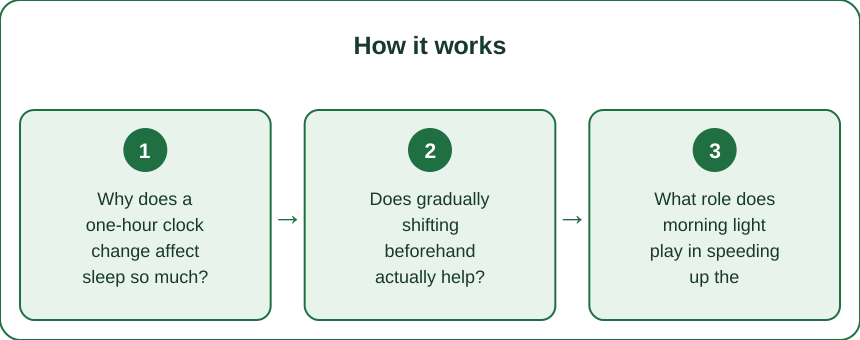
Why does a one-hour clock change affect sleep so much?
Your circadian rhythm is regulated primarily by light exposure, not the time displayed on a clock, so when daylight saving time shifts your schedule, your body’s internal clock is still calibrated to the old light pattern for several days. This mismatch between external clock time and internal biological time is what produces the grogginess, even though the actual disruption is smaller than jet lag across time zones.
Does gradually shifting beforehand actually help?
Yes — shifting your bedtime and wake time by 15-20 minutes per day for 3-4 days before the change, rather than absorbing the full hour at once, gives your circadian rhythm smaller, more manageable adjustments to make each day. This is the same principle used for adjusting to time zone changes before travel, applied to a smaller one-hour shift.
What role does morning light play in speeding up the adjustment?
Bright light exposure within 30-60 minutes of waking is one of the strongest signals your circadian rhythm uses to recalibrate, so getting outside or near a bright window shortly after waking on the days around the time change accelerates adjustment more than staying in dim indoor light. This matters more in the days immediately after the change than any other single habit.

Myth vs Fact: Daylight Saving Time Adjustment
Myth: Losing an hour of sleep once isn’t a big deal. Fact: The disruption isn’t really about losing an hour of sleep — it’s about the mismatch between your internal clock and the new external schedule, which can take several days to fully resolve.
Myth: You just have to push through the grogginess until your body catches up on its own. Fact: Gradual pre-shifting and deliberate morning light exposure measurably shorten the adjustment period compared to doing nothing.
What should you avoid doing in the days around the change?
Avoid bright screen light in the evening during the adjustment window, since evening light exposure works against the exact recalibration morning light is trying to achieve, effectively sending your circadian rhythm conflicting signals at the time it’s most sensitive to light cues.
FAQ: Adjusting to Daylight Saving Time, Answered
How many days does full adjustment typically take?
Most people fully adjust within 3-7 days, though gradual pre-shifting can shorten this noticeably.
Does caffeine timing matter more during this adjustment period?
Yes — avoiding caffeine within 8 hours of the new bedtime helps your body settle into the shifted schedule faster.
Is the spring or fall time change harder to adjust to?
Most people find the spring change (losing an hour) somewhat harder, since it requires waking earlier relative to your body’s existing rhythm.
TL;DR:
- Circadian rhythm responds to light exposure, not clock time, which is why the shift feels disruptive
- Shifting sleep by 15-20 minutes per day beforehand eases the transition
- Morning light exposure right after waking speeds up recalibration
- Avoid bright evening screens during the adjustment window
Start shifting your schedule a few days before the next time change — a gradual approach beats absorbing the full hour all at once.
Keep Reading
This article is for general informational purposes only and is not medical advice. Always consult a qualified health professional for guidance specific to you.