Adjusting Your Body Clock Before the Season Does It For You
Quick Answer: Daylight is currently shortening by two to three minutes per day, and the biggest circadian effect is the loss of early-morning light. Getting outside within an hour of waking, holding a consistent wake time, and dimming evening light are the three interventions with the strongest evidence - and starting them now is much easier than repairing a shifted rhythm later in autumn.
By the time most people notice the mornings are dark, their body clock has already drifted. The adjustment is far cheaper made in advance.
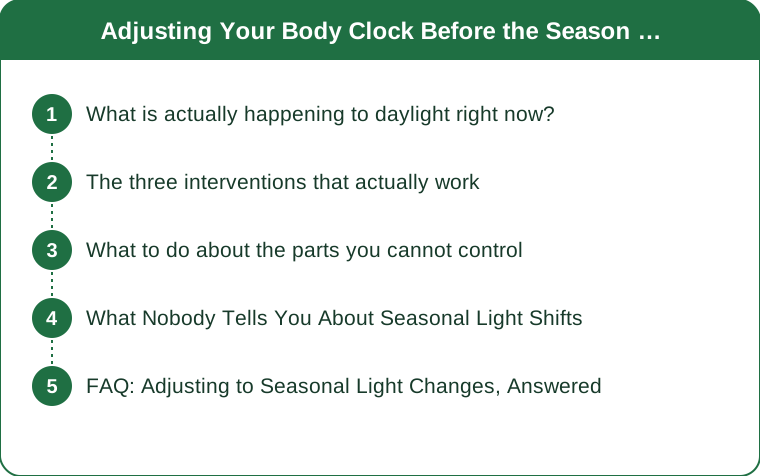
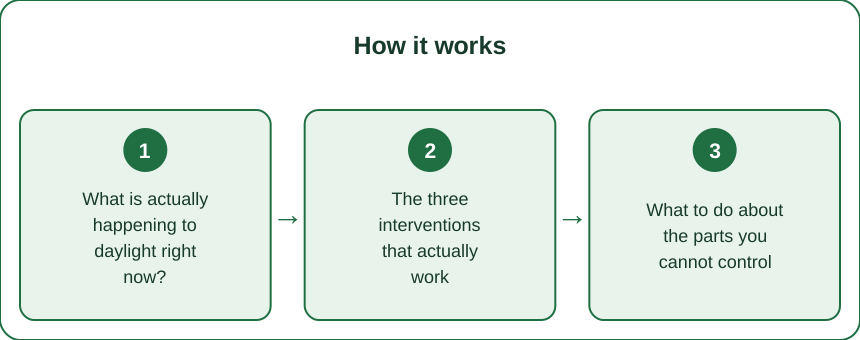
What is actually happening to daylight right now?
More than the calendar suggests, and asymmetrically.
The rate of change peaks around the equinoxes. Near the solstices, day length changes by seconds per day; near the equinoxes, by two to three minutes per day at mid-latitudes. Mid-August through October is the fastest-changing period of the year, and it accelerates through September.
The asymmetry is what matters. Sunrise and sunset do not shift equally. Through late summer, sunrise is moving later at a faster rate than sunset is moving earlier, which means the morning light loss arrives before the evening one.
Why the morning matters more than the evening: the circadian system is most sensitive to light in the hours around waking. Morning light advances the clock - pulling sleep and wake times earlier. Evening light delays it. Losing morning light and keeping bright evening indoor light pushes the whole rhythm later, which is exactly the drift most people experience in autumn.
What that drift feels like:
- Waking feels harder even at the same clock time
- Falling asleep gets later, gradually and unnoticed
- Afternoon energy dips deepen
- Mood dips in some people, which is well documented seasonally
The human clock runs slightly longer than 24 hours on average, which means it needs daily correction. Morning light is the primary correction signal. When the signal weakens, the drift is the default direction, not a personal failing.
The three interventions that actually work
Intervention 1: Morning outdoor light, within an hour of waking.
- Ten to twenty minutes on a clear morning; longer if overcast
- Outdoor light on a cloudy day is still many times brighter than indoor lighting - typical indoor light is a few hundred lux, overcast daylight is several thousand
- Through a window is substantially weaker than outdoors, because glass attenuates and you are further from the source
- This is the single highest-return sleep intervention, and it is free
Intervention 2: A consistent wake time, including weekends.
- Wake time anchors the rhythm more strongly than bedtime, because it determines when the light signal arrives
- A two-hour weekend shift produces something functionally similar to jet lag - the term used is social jet lag - and it takes days to recover
- Within about an hour of variance is a reasonable target, and it is far more achievable than perfection
Intervention 3: Dim the evening.
- Reduce overhead lighting for the last 60 to 90 minutes, using lamps instead
- Screen brightness matters less than total light exposure and timing - a dim room with a phone is better than a bright room without one
- Warm-toned light in the evening is a reasonable heuristic, though intensity matters more than colour
If you want to shift your schedule deliberately:
- Move in 15-minute increments every two or three days. Larger jumps do not hold.
- Change the wake time and the morning light first, and let bedtime follow
- Expect three to seven days for a one-hour shift to feel settled
On the clock change specifically: shifting your schedule by 15 minutes every few days in the week before it happens converts an abrupt one-hour jump into a gradual one. Most people do nothing and absorb it over a week of poor sleep.
What to do about the parts you cannot control
Not everyone can get outside at 7am, and the advice needs to survive that.
If you leave for work before sunrise:
- Get light at the first opportunity - a break, a lunchtime walk. Later light is less effective for advancing the clock but far better than none.
- A light therapy lamp used in the morning is a well-established option for people who cannot access daylight. Typical protocols use 10,000 lux at a specified distance for 20 to 30 minutes. Speak to a healthcare professional before starting one, particularly if you have any eye condition or bipolar disorder, where timing matters clinically.
- Maximise the light you do get - sit near windows, take calls outside, walk part of the commute
If your schedule is irregular:
- Anchor what you can. A consistent wake time on the days you control still stabilises the rhythm.
- Keep meal timing more regular than sleep timing if sleep cannot be regular - meal timing is a secondary circadian cue with real effects
- Protect the hour after waking more than any other part of the routine
If you are a genuine night type:
- Chronotype is substantially genetic and cannot be trained away entirely
- The goal is reducing the mismatch, not becoming a morning person. Even 30 to 45 minutes of shift reduces the daily friction meaningfully.
- Morning light is still the tool, applied at your waking time rather than at an idealised one
When to seek help: persistent insomnia, excessive daytime sleepiness, or a seasonal pattern of low mood that recurs annually are all worth discussing with a healthcare professional. Seasonal affective disorder and circadian rhythm disorders are recognised conditions with established treatments. This is general information, not medical advice.
What Nobody Tells You About Seasonal Light Shifts
The change is fastest right now, not in November. People associate dark mornings with midwinter, but the rate of change peaks near the equinox - the daily loss in September is roughly triple what it is in December. The disorientation of early autumn is partly about velocity rather than absolute darkness.
Cloudy outdoor light beats bright indoor light by an order of magnitude. A heavily overcast day still delivers several thousand lux; a well-lit office delivers a few hundred. ‘It is grey out, there is no point going outside’ is precisely backwards.
Sunglasses in the morning work against you. If you are trying to advance your clock, morning outdoor light without sunglasses is the signal. Save them for midday, unless there is a medical reason not to.
Evening exercise timing has a smaller effect than people think. Exercise does shift circadian timing, but the effect is modest compared to light. The more common problem is the bright gym at 9pm, not the exercise itself.
Caffeine’s half-life is around five to six hours for most adults, meaning a 3pm coffee still has a meaningful amount in your system at 9pm. As mornings get harder, caffeine intake tends to creep later, which then makes sleep onset harder, which makes mornings harder. It is a genuine feedback loop and it starts around now.
Sleep need does not increase in winter, but sleep opportunity often does - people go to bed earlier when evenings are dark, which is generally fine. The problem is when wake time drifts later at the same time, extending time in bed without improving sleep quality.
Children and teenagers shift later biologically, and adolescents in particular have a naturally delayed chronotype. The autumn schedule change hits them hardest, and morning light matters at least as much for them as for adults.
FAQ: Adjusting to Seasonal Light Changes, Answered
How much daylight are we actually losing?
Two to three minutes per day at mid-latitudes in late summer and autumn, accelerating toward the equinox. That is roughly an hour every three weeks.
Is morning light really that important?
It is the strongest available signal for setting circadian timing. Light in the hours after waking advances the clock; evening light delays it.
Does light through a window count?
It helps but is much weaker than being outside. Glass attenuates the light and indoor positions are far from the source - stepping outside for ten minutes beats an hour by a window.
How should I handle the clock change?
Shift your schedule by 15 minutes every two or three days in the preceding week, so the change is gradual rather than abrupt.
Do light therapy lamps work?
They are well established for seasonal low mood and circadian adjustment, typically at 10,000 lux for 20 to 30 minutes in the morning. Speak to a healthcare professional first, especially with any eye condition or bipolar disorder - this is general information, not medical advice.
TL;DR:
- Daylight is changing fastest right now - two to three minutes per day, not in midwinter
- Morning light advances the clock; evening light delays it, so the morning is what to protect
- Consistent wake time anchors the rhythm more effectively than bedtime does
- Overcast outdoor light is many times brighter than any indoor lighting
- Shift deliberately in 15-minute steps, and start before the clocks change rather than after
The cheapest circadian intervention available is ten minutes outside shortly after waking. Starting it in August is considerably easier than repairing a drifted rhythm in November.
Keep Reading
This article is for general informational purposes only and is not medical advice. Always consult a qualified health professional for guidance specific to you.