Your Morning Light Habit Is About to Stop Working - Here Is the Fix
Quick Answer: Morning light anchors your body clock, and as sunrise moves later your usual light window disappears while your alarm stays put. Three fixes, in order of value: get outside at whatever the brightest point of your morning is, even if that’s mid-morning rather than on waking; move light-dependent activities like a walk or coffee to the lightest available slot; and add a bright light lamp used shortly after waking if outdoor light isn’t available before you start work. Start now, before the mismatch is large, rather than in November when you’re already struggling.
All summer you woke at six and it was light. In six weeks you’ll wake at six into darkness, and your body will treat that as the middle of the night - because from its point of view, it is.

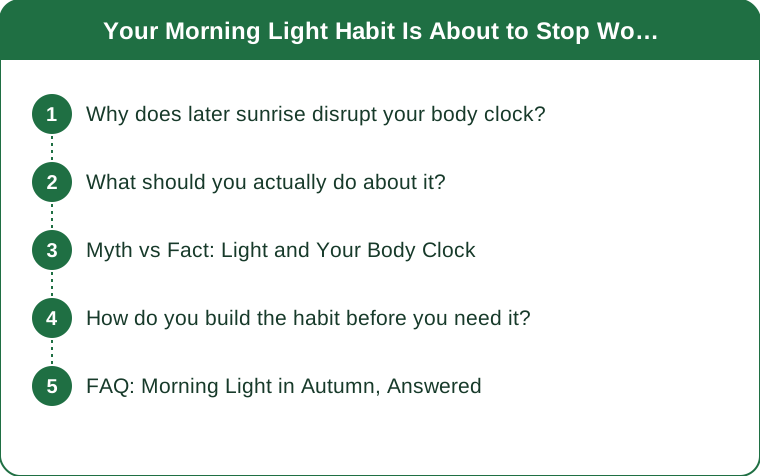
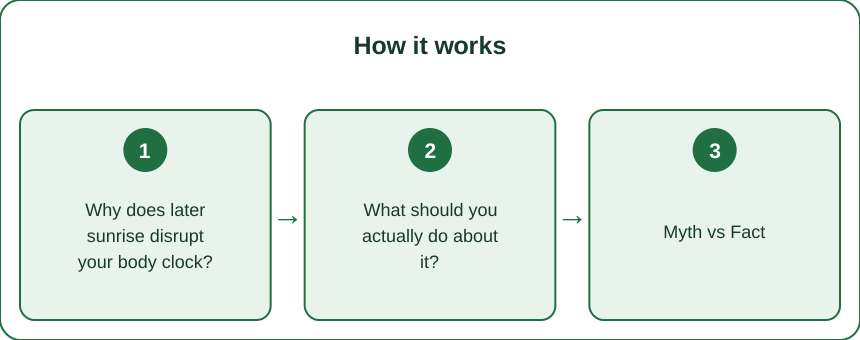
Why does later sunrise disrupt your body clock?
Light is the main signal that sets your internal clock. Morning light exposure is what keeps your circadian rhythm aligned to the day, and its timing does most of the work. Remove it and the clock drifts.
Your alarm doesn’t move but the sun does. Waking at a fixed time while sunrise moves later creates a growing gap between your social schedule and your biological one, which is felt as grogginess, later sleepiness at night, and harder mornings.
Indoor light is much weaker than it feels. Typical indoor lighting is a small fraction of outdoor daylight intensity - even an overcast day outside is far brighter than a well-lit room. Your eyes adapt so you don’t perceive the difference, but your clock does.
The drift is gradual, so nobody adapts in time. Losing a minute or two of morning light a day is invisible week to week and adds up to a substantially different morning within two months.
Evening light compounds it. Bright screens and lights late in the evening push the clock later at the same time as reduced morning light fails to pull it earlier - the two effects work in the same direction.
And most people blame the season rather than the signal. Autumn tiredness gets treated as an unavoidable mood, when a large part of it is a solvable light-timing problem.
What should you actually do about it?
Get outside for ten to twenty minutes at the brightest available point in your morning. Outdoor light on an overcast day still substantially exceeds indoor lighting. The walk to the shops, the school run, or ten minutes with a coffee outside all count.
If you can’t get out early, get out later rather than not at all. Mid-morning outdoor light is far more useful than no outdoor light. The ideal is soon after waking; the practical version is whenever you can.
Move an existing habit into the light rather than adding a new one. Coffee on the doorstep instead of at the table, a phone call taken on a walk, the dog walk moved earlier. Relocating a habit is far more durable than inventing one.
Consider a bright light lamp if your mornings are genuinely dark. Bright light devices designed for this purpose are widely used for winter mornings, typically shortly after waking for a set period. If you have eye conditions, take medication that increases light sensitivity, or have bipolar disorder, check with a clinician before starting - this is general information, not medical advice.
Sit near the window while you work. Weaker than outdoors but far better than an interior room, and it costs nothing.
And keep your wake time consistent across the week. A stable wake time is one of the strongest anchors available, and weekend lie-ins undo a lot of the weekday work.

Myth vs Fact: Light and Your Body Clock
Myth: You need direct sunlight. Fact: overcast outdoor light is still dramatically brighter than indoor lighting, and it’s enough. Waiting for a sunny day is not the standard.
Myth: Sitting by a window is the same as being outside. Fact: glass and distance cut intensity substantially. A window seat helps and it’s not equivalent - going outside for ten minutes typically beats an hour at a desk by the window.
Myth: Light in the evening doesn’t matter if you get morning light. Fact: both ends matter. Bright evening light pushes the clock later, working directly against your morning efforts.
Myth: You need an expensive lamp. Fact: for most people, outdoor light plus a consistent wake time solves it. Lamps are useful for people whose mornings are genuinely dark before work, not a default purchase.
Myth: More sleep fixes autumn tiredness. Fact: if the problem is timing rather than duration, more hours in bed doesn’t help - and can make it worse by shifting your clock later still. Timing and duration are separate levers.
Myth: You should wait until the clocks change to adapt. Fact: the drift starts now and builds gradually. Adapting in advance is much easier than correcting a large mismatch later.
How do you build the habit before you need it?
Start this week, while it’s still light at your usual wake time. Building the outdoor-in-the-morning habit while it’s pleasant means it’s established by the time it’s genuinely dark and cold.
Anchor it to something you already do daily. First coffee, the walk to the car, letting the dog out. The habit needs a host, not a slot.
Plan the winter version now. Decide in advance what you’ll do when it’s dark at wake time - lamp, mid-morning walk, window desk - so you’re not solving it in November while tired.
Protect the evening end too. Dimming lights and reducing bright screens in the last hour supports the same clock you’re anchoring in the morning.
Keep the wake time steady, including at weekends. A wake time that drifts by two hours at weekends creates a recurring mismatch that undermines everything else.
And treat persistent low mood as separate. Significant seasonal low mood, loss of interest, or sleep problems that don’t respond to these changes are worth discussing with a clinician. Seasonal patterns of depression are recognised and treatable, and light habits are a supporting measure rather than a substitute for care.
FAQ: Morning Light in Autumn, Answered
Does morning light still work if it’s cloudy?
Yes. Outdoor light on an overcast day is still far brighter than typical indoor lighting, and it’s sufficient to help anchor your body clock. Sunny days aren’t required.
When should I start using a light therapy lamp?
When outdoor light isn’t realistically available before you start your day - which for most people is once sunrise falls later than their wake time. If you have eye conditions, light-sensitising medication, or bipolar disorder, check with a clinician first.
How long do I need to be outside in the morning?
Ten to twenty minutes is a commonly suggested starting point, and more is generally better. Getting out later in the morning is much better than not getting out at all.
Why am I so tired when the mornings get darker?
Your wake time stays fixed while the light signal that anchors your clock arrives later, creating a growing mismatch. It’s usually a timing problem rather than a sleep-duration problem, which is why sleeping longer often doesn’t help.
TL;DR:
- Morning light is the main anchor for your body clock, and later sunrise gradually removes it while your alarm stays fixed.
- Outdoor light even on an overcast day massively exceeds indoor lighting - ten to twenty minutes outside is the highest-value fix.
- Relocate an existing habit into the light rather than adding a new one, and sit near a window when you can’t get out.
- Consider a bright light lamp if your mornings are genuinely dark before work, with clinician advice in specific circumstances.
- Keep wake time consistent including weekends, and protect the evening end by dimming lights and screens.
Build the habit while it’s still pleasant. Nobody starts a new morning routine in November.
Keep Reading
This article is for general informational purposes only and is not medical advice. Always consult a qualified health professional for guidance specific to you.