Night Owl, Early World: Shifting Your Clock Without Hating Your Life
Quick Answer: To shift a night-owl clock earlier, move your wake time 15 minutes earlier every 3–4 days — not your bedtime — and get bright light within 30 minutes of waking. Dim the evenings, and keep weekend wake times within an hour of weekdays. Expect a realistic shift of 60–90 minutes over 3–4 weeks.
Some of us are built for midnight. Genuinely, genetically. And yet the world schedules dentist appointments at 8am with total impunity.
If your owl clock keeps crashing into an early-bird life, here’s the shift protocol that works with your biology instead of declaring war on it.

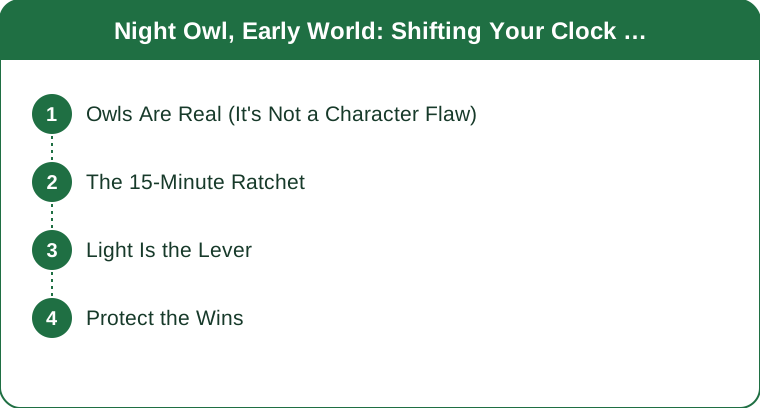
Are Night Owls Real, or Just Undisciplined?
Real. Chronotype is substantially genetic — variations in clock genes like PER3 and CRY1 shift the whole system later, and an owl’s melatonin release simply ships 1–3 hours later than a lark’s.
That’s not a character flaw, and it isn’t fixed by trying harder. It’s why “just go to bed earlier” fails: you can lie in a dark room at 10:30pm being biologically wide awake for as long as you like.
The realistic goal isn’t becoming a 5am person. It’s nudging your clock 60–90 minutes so mornings stop feeling like an assault. That’s achievable, and it’s usually enough to make a 9am life workable.
Why Shift Wake Time Instead of Bedtime?
Because you can control an alarm and you cannot control falling asleep.
Move your wake time 15 minutes earlier every 3–4 days. Sleep pressure follows the alarm within a few days — get up earlier, and by night three or four you’ll genuinely feel sleepy earlier. Bedtime shifts itself, which is the only way it ever moves.
Cold-turkey 6am resolutions crash by Thursday because they front-load all the sleep debt at once. The ratchet compounds instead: six steps of 15 minutes over three weeks gets you a full 90-minute shift with no single day that feels brutal.
If a step feels rough, hold it for a week before taking the next one. There’s no schedule to keep.

How Does Light Shift Your Clock?
Light is the lever. Everything else is support.
Bright light within 30 minutes of waking — outside if at all possible — pulls your clock earlier. Outdoor light on an overcast morning is around 1,000–10,000 lux; indoor lighting is maybe 100–300. The gap is enormous, which is why standing at a window beats any lamp, and why 10–20 minutes outside is the single highest-return action in this whole protocol.
Dim the evenings to stop it drifting back. From about two hours before your target bedtime, drop overhead lights, use lamps, and get the big bright screen out of your face — or at least off your retinas at close range.
The owl’s true enemy is not the alarm. It’s the 11pm big-screen sunbath.
How Do You Keep the Shift From Sliding Back?
Weekends. It’s always weekends.
Sleeping in more than about an hour past your weekday wake time refunds the week’s shifting — researchers call the mismatch social jet lag, and it’s essentially flying two time zones west every Friday and back every Monday.
Anchor weekend wake times within 60 minutes of weekdays. If you’re short on sleep, take it as an early-afternoon nap of 20–30 minutes rather than a late morning. Naps after about 3pm start eating into that night’s sleep pressure.
The clock rewards boring consistency, annoyingly.
Myth vs Fact
Myth: Everyone can become a morning person with enough discipline. Fact: Chronotype is largely genetic and shifts modestly, not completely. Most owls can move 1–2 hours with consistent light and timing. Expecting to become a natural 5am riser sets you up to quit.
Myth: Melatonin supplements are sleeping pills. Fact: For circadian shifting, melatonin works as a timing signal, not a sedative — small doses taken several hours before target bedtime are the usual approach. Dose and timing matter a lot, so this is a conversation to have with a doctor or pharmacist rather than a guess at the shop.
Myth: You can catch up on sleep at the weekend. Fact: You can partially repay sleep debt, but you do it at the cost of your circadian alignment. The trade is usually bad for owls specifically, because the drift is the exact thing you’re fighting.
Myth: Being an owl is unhealthy. Fact: Being an owl forced onto a lark schedule is what’s associated with poor outcomes. The problem is the mismatch, not the chronotype — which is also why a job with a later start can be a legitimate solution.
When Should You See a Professional?
If you routinely can’t fall asleep before 2–4am no matter what you do, and this has been going on for months, that pattern has a name — delayed sleep-wake phase disorder — and it’s treatable with structured light therapy and timed melatonin under supervision.
Also worth a doctor’s visit if you’re getting adequate hours but still exhausted, if you snore heavily or wake gasping, or if low mood is riding along with the sleep problem. Those are different mechanisms and they don’t respond to a wake-time ratchet.
Mini FAQ
How long does the whole shift take?
Plan for 3–4 weeks for a 60–90 minute change, and expect to maintain it deliberately rather than assuming it sticks. The first week is the hardest by a wide margin.
Does coffee ruin it?
Not if it’s early. Caffeine has a half-life of around 5–6 hours, so a 4pm coffee still has a meaningful amount in your system at 10pm. Set a personal cutoff around eight hours before target bedtime and the morning coffee stays entirely fine.
What about a sunrise alarm clock?
Genuinely useful for owls, especially in winter when your alarm goes off in the dark. It won’t replace getting outside, but it makes the first ten minutes far less hostile — and for many people that’s the difference between getting up and negotiating.
TL;DR:
- Chronotype is genetic; aim for a 60–90 minute shift, not a personality transplant.
- Ratchet the wake time 15 minutes earlier every 3–4 days. Bedtime follows.
- Get 10–20 minutes of outdoor light within 30 minutes of waking.
- Dim lights and screens for two hours before target bedtime.
- Keep weekends within an hour of weekdays; nap early-afternoon if needed.
Ratchet the wake time, flood the mornings with light, dim the nights, hold weekends steady. You’ll remain an owl at heart — just one who can attend 9am meetings without plotting anything.
Keep Reading
This article is for general informational purposes only and is not medical advice. Always consult a qualified health professional for guidance specific to you.