Why Traveling Just One Time Zone Still Throws Off Your Sleep
Quick Answer: Even a single hour of time zone difference misaligns your circadian rhythm with local light-dark cues, and while the effect is smaller than crossing several zones, it’s genuinely measurable — which is why a ‘quick’ one-hour-shift trip can still leave you feeling subtly off for a day or two, more than most people expect from such a small change.
A one-hour time difference feels too small to cause real jet lag, so when you still feel subtly off for a day or two after a short trip, it’s easy to assume it’s something else. It’s genuinely the time shift.

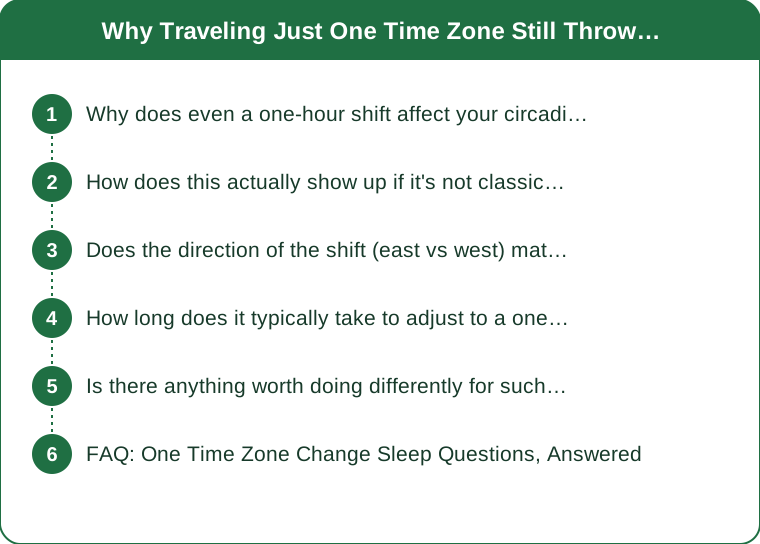
Why does even a one-hour shift affect your circadian rhythm at all?
Your circadian rhythm is calibrated to local light exposure timing, and it doesn’t distinguish between a ‘small’ and ‘large’ misalignment in kind — only in degree. A one-hour shift means your body’s internal clock and the local light-dark cycle are genuinely out of sync, just less severely than a six-hour shift would be.
How does this actually show up if it’s not classic ‘jet lag’?
Rather than the more dramatic exhaustion of long-haul jet lag, a one-hour shift more commonly shows up as subtly disrupted sleep quality — waking slightly earlier or later than intended, feeling not quite rested despite a full night, or a mild energy dip at an unexpected time of day.
Does the direction of the shift (east vs west) matter for a single hour too?
Yes, the same general pattern holds even at this smaller scale — shifting your schedule earlier (as when traveling east) tends to be mildly harder to adjust to than shifting later (traveling west), since it’s generally easier for the body to stay up later than to fall asleep earlier than usual.

How long does it typically take to adjust to a one-hour shift?
Usually just a day or two for most people, compared to the roughly one-day-per-time-zone rule of thumb often cited for larger jet lag — the smaller scale of the shift means recovery is proportionally faster, but it’s rarely instant.
Is there anything worth doing differently for such a small shift?
Getting morning light exposure aligned with the new local time as soon as possible on day one is a low-effort way to speed up adjustment, even for a one-hour difference — it’s the same core strategy used for larger jet lag, just needed for a shorter adjustment window.
FAQ: One Time Zone Change Sleep Questions, Answered
Is a one-hour time change worse for some people than others?
Yes — individual sensitivity to circadian disruption varies, and people who already have less stable sleep tend to notice even small shifts more than people with very consistent sleep habits.
Does daylight saving time cause a similar effect?
Yes — the twice-yearly daylight saving shift is functionally a one-hour circadian disruption for an entire population at once, and it follows a similar, well-documented adjustment pattern.
Should I bother adjusting my schedule in advance for such a small shift?
For most one-hour trips it’s not usually necessary, but shifting your bedtime by 20-30 minutes the night before can take some of the edge off if you’re particularly sensitive to sleep disruption.
TL;DR:
- Even a one-hour time zone shift genuinely misaligns your circadian rhythm, just to a smaller degree
- It usually shows up as subtly disrupted sleep quality rather than classic jet lag exhaustion
- Eastward (earlier) shifts are still mildly harder to adjust to than westward ones, even at this scale
- Morning light exposure aligned with local time speeds up adjustment for small shifts too
Feeling subtly off after a ‘quick’ one-hour trip isn’t in your head — it’s a real, if small, circadian effect.
Keep Reading
This article is for general informational purposes only and is not medical advice. Always consult a qualified health professional for guidance specific to you.