Why You Wake Up at the Exact Same Time Every Night (It's Not a Coincidence)
Quick Answer: Waking at a consistent time nightly - often 3-4am - usually reflects a natural dip in your sleep cycle combined with a learned pattern your circadian rhythm has reinforced through repetition. It’s rarely random; your body clock genuinely tracks time even during sleep, and waking at the same point night after night often becomes self-reinforcing.
It’s never 2:47am or 4:12am - it’s always right around 3:15am, like clockwork. That specificity feels eerie, but there’s a real circadian explanation, and a real fix that doesn’t involve just “trying to sleep through it.”

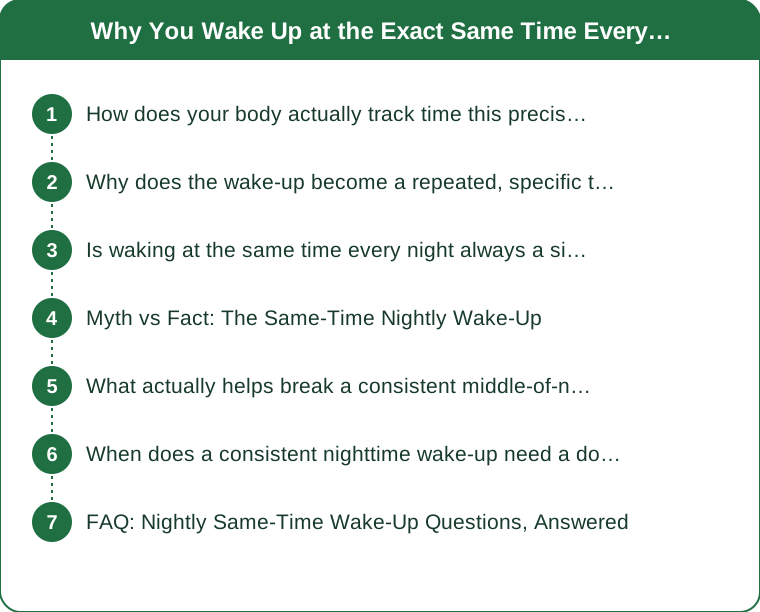
How does your body actually track time this precisely during sleep?
Your circadian rhythm - the roughly 24-hour internal clock governed largely by the brain’s suprachiasmatic nucleus - continues operating throughout sleep, not just while you’re awake. It regulates core body temperature, hormone release (including cortisol and melatonin), and sleep stage transitions on a fairly precise internal schedule, which is why a consistent nightly wake time isn’t actually as mysterious as it feels.
Most sleep cycles run in roughly 90-minute blocks, and a natural, brief lightening of sleep depth happens at the boundary between cycles - if your bedtime is consistent, these cycle boundaries land at similar clock times night after night, which is a large part of why the exact same wake-up time keeps showing up.
Why does the wake-up become a repeated, specific time instead of random?
Once you’ve woken at a specific time a few nights in a row, your body can start to anticipate it - a mild, learned expectation effect that’s well documented in circadian research. This isn’t conscious or intentional; it’s closer to how your body might start expecting a meal at a regular time if you eat at the same hour daily, applied to a sleep-cycle transition point instead.
Cortisol - a hormone that naturally begins rising in the hours before your typical wake time to help prepare your body for waking - can also start rising slightly earlier than needed if a stress pattern or anxiety has become associated with that particular time, which is part of why stress-related early waking often clusters around a specific hour rather than happening randomly across the night.
Is waking at the same time every night always a sign something is wrong?
Not necessarily - a brief, several-second waking at a consistent cycle-boundary time, that you don’t remember and that doesn’t lead to trouble falling back asleep, is a completely normal part of typical sleep architecture and happens to most people multiple times a night without any lasting awareness of it.
It becomes worth addressing specifically when the waking is followed by 20+ minutes of being unable to fall back asleep, or when it’s accompanied by racing thoughts, anxiety, or physical discomfort - that combination points toward a stress or sleep-quality issue worth actively addressing, rather than simply a normal sleep cycle transition you happened to notice.

Myth vs Fact: The Same-Time Nightly Wake-Up
Myth: Waking at exactly the same time every night means something is medically wrong. Fact: It’s frequently just a normal circadian sleep-cycle boundary effect, especially if you fall back asleep easily - only prolonged, distressing wake-ups warrant medical attention, not the pattern of consistent timing alone.
Myth: The specific time you wake up (like 3am specifically) has some special significance. Fact: The specific hour is determined by your individual bedtime and typical sleep cycle length, not any inherent property of that particular time - two people with different bedtimes will have their own consistent wake time that’s meaningful to their schedule, not a universal number.
Myth: If you wake at the same time nightly, you should just get up rather than try to fall back asleep. Fact: For most people, calmly staying in bed and using a relaxation technique to fall back asleep works better than getting up, unless you’ve been lying awake for more than roughly 20 minutes with no signs of drowsiness returning.
What actually helps break a consistent middle-of-night wake-up pattern?
Keeping a highly consistent bedtime and wake time, even on weekends, tends to reduce the anticipatory effect over 2-3 weeks, since inconsistent sleep timing actually reinforces circadian confusion rather than resolving it. This runs counter to the instinct to sleep in after a rough night, but consistency is generally the more effective long-term fix.
If the wake-up is stress-associated, addressing pre-bed stress and anxiety directly - a wind-down routine, journaling worries out of your head before bed rather than during the 3am wake-up - tends to reduce how often the anxious version of this pattern recurs.
Avoid checking the clock during the wake-up itself. Confirming the time reinforces the pattern (“see, it’s 3:15 again”) and can increase anxiety about the wake-up recurring, which paradoxically makes it more likely to keep happening at that same hour.
When does a consistent nighttime wake-up need a doctor’s input?
If the pattern is new, worsening, or consistently prevents you from falling back asleep for 30+ minutes, or if it’s paired with other symptoms like snoring, gasping, or excessive daytime fatigue, that combination is worth bringing to a doctor rather than just managing sleep hygiene changes on your own - some of these signs can point toward a sleep disorder that needs proper evaluation.
This is general information, not medical advice - persistent sleep disruption that affects your daily functioning deserves a professional look rather than ongoing self-management alone.
FAQ: Nightly Same-Time Wake-Up Questions, Answered
Is a specific wake-up time linked to a specific health condition, like some online sources claim?
There’s no solid scientific evidence supporting the popular claims linking specific hours to specific organs or emotions - the actual explanation is your individual sleep cycle timing and circadian rhythm, not a symbolic meaning tied to the clock number itself.
Does age affect how often this happens?
Yes - middle-of-night waking becomes somewhat more common with age due to natural shifts in sleep architecture, including lighter overall sleep and more frequent cycle-boundary awakenings, even in otherwise healthy sleep.
Can stress really cause a wake-up to happen at the exact same time repeatedly?
Yes - once cortisol release or anticipatory anxiety becomes associated with a specific hour, it can genuinely reinforce a wake-up recurring around that same time night after night, which is why addressing the underlying stress often resolves the pattern more effectively than only addressing the wake-up itself.
TL;DR:
- Your circadian rhythm keeps precise time even during sleep, which explains consistent wake-up timing
- A brief wake at a sleep-cycle boundary is normal; trouble falling back asleep for 20+ minutes is the actual concern
- Consistent bedtime and wake time, even on weekends, helps reduce the anticipatory pattern
- Avoid checking the clock during a nighttime wake-up, since it can reinforce the pattern
This is general information, not medical advice - a new, worsening, or distressing wake-up pattern deserves a doctor’s evaluation rather than self-management alone.
Keep Reading
This article is for general informational purposes only and is not medical advice. Always consult a qualified health professional for guidance specific to you.