Why Your Body Clock and Your Alarm Start Disagreeing in September
Quick Answer: Your circadian clock is set primarily by morning light. As sunrise moves later through late summer and autumn, the light signal that used to arrive before your alarm now arrives after it, so your clock drifts later while your alarm stays fixed. The fix is to restore an early light signal - bright light within 30 minutes of waking, outdoors if possible, or a light box if it is still dark.
Nothing about you has changed. The sun is simply coming up later than it was eight weeks ago, and your clock believes the sun.

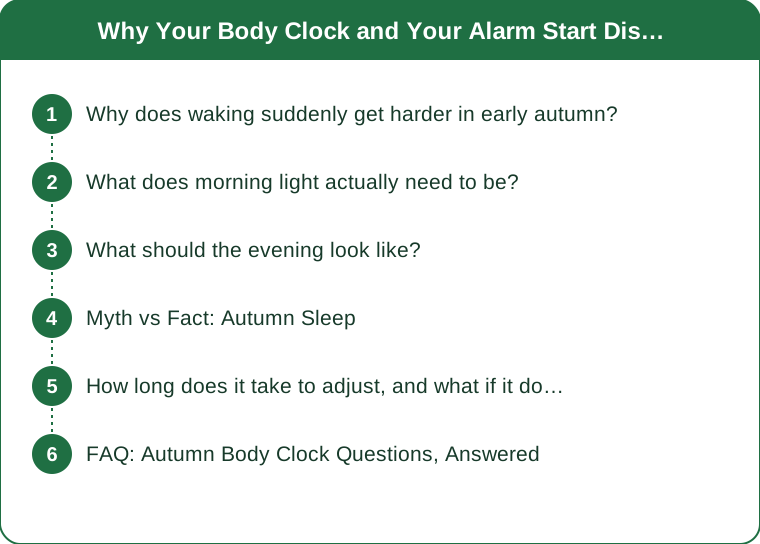
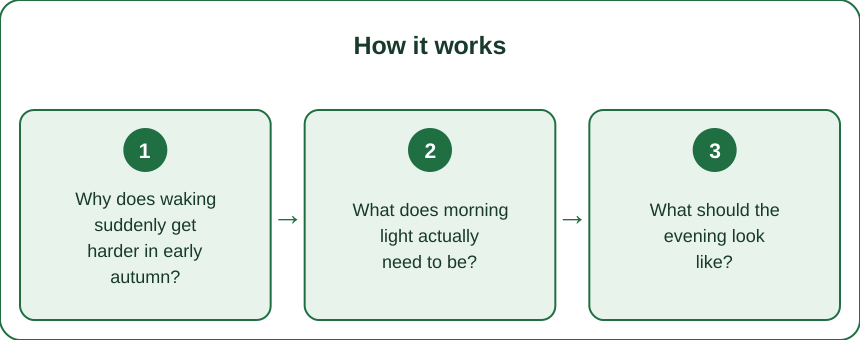
Why does waking suddenly get harder in early autumn?
Because the strongest input to your body clock has moved and your schedule has not.
How the clock is set. Specialised cells in the retina detect light - particularly blue-wavelength light - and send that signal to the suprachiasmatic nucleus, the master clock in the hypothalamus. Morning light advances the clock, making you sleepy earlier and waking you earlier. Evening light delays it.
What changes in late summer and early autumn. In mid-latitudes, sunrise moves later by roughly a minute or two a day through this period. That accumulates: by early September, sunrise can be well over an hour later than it was at the solstice, and it continues moving.
The mismatch that produces: if you wake at 6:30, you were previously waking into daylight that had been present for two hours. Now you wake into near-darkness. The signal that used to pull your clock earlier every morning has been quietly removed, so your clock drifts later while your alarm does not.
What that feels like:
- Waking feels harder and groggier, even with the same amount of sleep
- You feel alert later in the morning than you used to
- You are not tired at your usual bedtime, which compresses sleep from the other end
- The 3pm dip can feel more pronounced
Why the sleep amount is not the issue. People typically respond by trying to sleep more, and it often does not help, because the problem is timing rather than duration. Eight hours at the wrong phase feels worse than seven at the right one.
What does morning light actually need to be?
Brighter and earlier than most people assume, and indoor lighting does not qualify.
The intensity gap is enormous. Typical indoor lighting sits in the range of a few hundred lux. An overcast day outdoors is commonly cited in the thousands, and direct sunlight far higher. Stepping outside on a grey morning delivers a light signal an order of magnitude stronger than sitting by a window with the lights on.
What works:
- Ten to twenty minutes outdoors within 30 to 60 minutes of waking. The single most effective intervention, and it works on cloudy days
- A walk rather than sitting, because you get the light plus movement plus a consistent behavioural anchor
- A light therapy box if it is genuinely dark when you wake. Typically 10,000 lux at the recommended distance, used for 20 to 30 minutes while you do something else. This is what these devices are designed for
- A dawn simulator alarm, which brightens gradually before your alarm. The evidence is less strong than for a light box and many people find waking noticeably easier with one
What does not work well:
- Light through a closed window, which is filtered substantially. Better than nothing and much weaker than being outside
- Phone screens. The intensity is far too low to shift a circadian clock, whatever their reputation. Phones affect sleep mainly through content and arousal rather than through lux
- Turning on the lights indoors, which is roughly two orders of magnitude short
Timing matters more than duration. Twenty minutes at 7am does far more than an hour at 11am. The clock is most sensitive to light shortly after your habitual wake time, which is exactly the window most people spend indoors getting ready.
What should the evening look like?
Dimmer, earlier, and more consistent - because evening light pushes the clock in the opposite direction.
The mechanism. Bright light in the evening delays the clock, making you feel alert later and wake later. In autumn, that combines badly with a late-arriving morning signal: you are getting a weak advance signal in the morning and a normal delay signal at night, so the clock drifts later on both ends.
Practical evening adjustments:
- Dim the overhead lights an hour or two before bed. Lamps rather than ceiling lights, and warmer bulbs
- Get outside in the late afternoon if you can. Late daylight is useful for overall entrainment and it is the easiest daylight to access in autumn
- Keep the bedroom genuinely dark. Light leakage from streetlights and standby LEDs affects sleep quality more than most people credit
- Keep your wake time consistent, including weekends. A two-hour weekend lie-in produces a phase shift comparable to travelling across time zones, and Monday morning is where you pay for it
On screens, honestly. The lux from a phone is far too low to move a circadian clock meaningfully. What screens do is keep you engaged, aroused, and awake past the point you would otherwise have stopped, which delays sleep by behaviour rather than by biology. The practical advice is the same, but the reason matters - night mode on your phone is not the intervention people think it is.
On melatonin supplements: a small dose taken several hours before bed acts as a timing signal rather than a sedative, and the timing is what matters. Availability, regulation, and appropriate use vary considerably by country, so it is worth discussing with a doctor or pharmacist rather than treating it as an over-the-counter sleeping aid.

Myth vs Fact: Autumn Sleep
Myth: You need more sleep in autumn. Fact: Sleep need is fairly stable across the year for most adults. What changes is the timing of the signal that sets your clock, and mistiming feels like insufficiency.
Myth: Blue light from screens is what is ruining your body clock. Fact: Screen intensity is far too low to shift circadian timing meaningfully. Screens delay sleep by keeping you engaged and aroused, not by their light output. The fix is putting the phone down, not filtering it.
Myth: A lie-in at the weekend helps you catch up. Fact: It repays some sleep debt and shifts your clock later, which is why Monday feels worse. Consistent wake times cost you an hour on Saturday and save you Monday and Tuesday.
Myth: If you are tired in the morning, go to bed earlier. Fact: If your clock has drifted later, lying in bed earlier produces frustration rather than sleep. Fixing the morning light usually shifts bedtime earlier on its own - which is the counterintuitive part most people never try.
Myth: Light boxes are only for seasonal affective disorder. Fact: They are used for SAD and also for circadian timing generally, including shift work and jet lag. For anyone waking before sunrise in autumn and winter, a light box is a reasonable substitute for the sunrise that has not happened yet.
Myth: You just have to accept feeling worse until spring. Fact: The timing mismatch is largely correctable with light exposure and schedule consistency. The seasonal mood component is separate and also treatable.
How long does it take to adjust, and what if it does not?
About one to two weeks of consistent morning light for most people, and there are specific signs that something else is going on.
A realistic protocol:
Days 1 to 3: Fix the wake time and get outside within an hour of waking for at least ten minutes, every day including the weekend. Expect no change yet.
Days 4 to 7: Most people notice mornings feeling slightly less heavy. Evening sleepiness may start arriving earlier.
Week 2: The clock has usually shifted. Bedtime moves earlier by itself, which is the sign it is working.
Week 3 onward: Maintenance. As sunrise keeps moving later through autumn, you may need to switch from outdoor light to a light box to keep the signal at a consistent clock time.
What makes it fail:
- Inconsistency. Three days on and two days off does not shift a clock. This is the main reason people conclude it does not work
- Weekend drift, which undoes the weekday gains
- Getting the light too late. Light at 10am is much weaker as a phase-advancing signal than light at 7am
When it is worth speaking to a doctor:
- Persistent low mood, loss of interest, or significant change in appetite through autumn and winter, which may indicate seasonal affective disorder - a genuine and treatable condition rather than a mood
- Loud snoring, gasping in sleep, or profound daytime sleepiness despite adequate sleep, which can indicate sleep apnoea and is frequently undiagnosed in women
- Fatigue that does not respond to any sleep improvement, which is worth investigating rather than optimising around - thyroid function and iron studies are common and reasonable first checks
- Insomnia lasting more than a few weeks, for which cognitive behavioural therapy for insomnia is the recommended first-line treatment and is more effective long-term than medication
This is general information rather than medical advice.
FAQ: Autumn Body Clock Questions, Answered
Why is it harder to wake up in September than in June?
Sunrise has moved substantially later, so the morning light that used to set your clock now arrives after your alarm. Your clock drifts later while your schedule stays fixed.
How much morning light do I need?
Ten to twenty minutes outdoors within an hour of waking, on most days including weekends. Cloudy days still deliver far more light than indoor lighting.
Do light therapy boxes work?
For circadian timing, yes - they are designed for exactly this. Typically 10,000 lux for 20 to 30 minutes shortly after waking, used while doing something else.
Is blue light from my phone the problem?
Not for circadian timing - the intensity is far too low. Phones delay sleep by keeping you engaged rather than by their light output.
How long before I notice a difference?
Usually one to two weeks of consistent morning light. The clearest sign it is working is that you start feeling sleepy earlier without trying.
TL;DR:
- Morning light sets your clock, and sunrise has moved well over an hour later since June
- The alarm did not change, so the clock drifts later while the schedule stays fixed
- Ten to twenty minutes outdoors within an hour of waking, most days, is the highest-value fix
- Indoor lighting is roughly two orders of magnitude too weak; a 10,000 lux light box substitutes when it is still dark
- Consistent wake times including weekends matter more than total hours
If mornings got harder in the last few weeks and nothing else changed, look at what time the sun is coming up now versus in June.
Keep Reading
This article is for general informational purposes only and is not medical advice. Always consult a qualified health professional for guidance specific to you.