When Your Body Clock and Your Partner's Disagree
Quick Answer: Chronotype is substantially genetic and only shifts by roughly an hour or two with deliberate light management - so trying to convert a night owl into a lark usually fails. The workable approach is to protect the sleep of whoever is asleep: separate bedding, a properly dark room, a wearable alarm rather than an audible one, and one shared anchor point in the day that is not bedtime.
One of you is asleep at 10pm and cheerful at 6am. The other becomes a functioning human at 10:30pm and considers 7am a personal attack. Neither of you is doing it on purpose, and after a while the mismatch stops being a joke and starts being an argument about lights.
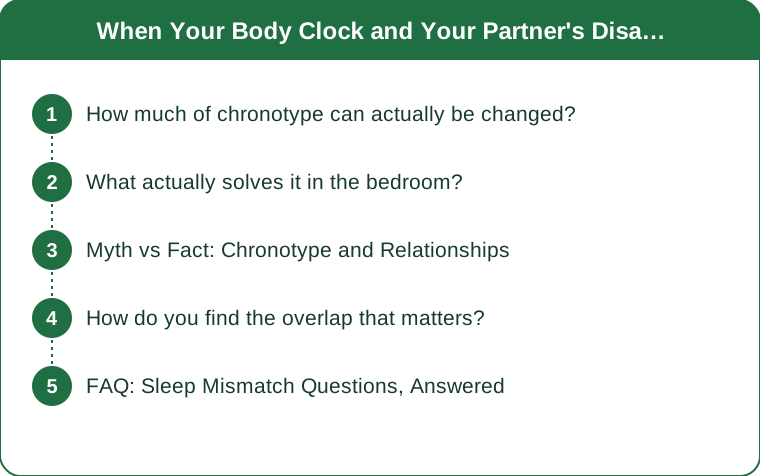
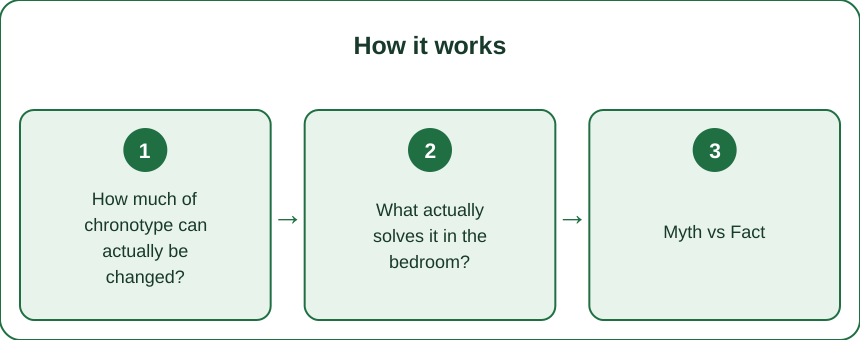
How much of chronotype can actually be changed?
Less than the self-improvement industry implies, and more than a committed night owl usually believes.
Chronotype has a substantial genetic component. Variants in clock genes such as PER and CRY influence the length of your internal circadian period and where your sleep window naturally falls. This is why morning-person advice frequently fails: it is asking someone to override a biological setting rather than a habit.
Age moves it predictably. Chronotype shifts later through adolescence, peaks in lateness around 20, then drifts earlier through adulthood. A couple who were aligned at 25 can be genuinely out of phase at 40 without either of them changing anything.
Light can shift it, within limits. Bright light in the morning advances the clock earlier; bright light in the evening delays it. Consistent morning light exposure and dimmer evenings can typically move a sleep window by around one to two hours over several weeks. That is a real and useful shift, and it is not a conversion.
And forcing it has costs. A late chronotype living on an early schedule accumulates social jetlag - the difference between the sleep timing your body wants and the sleep timing your obligations require. That mismatch is associated with poorer sleep quality, worse mood, and higher daytime sleepiness, and it does not resolve by trying harder.
So the realistic frame is: each person can move an hour or so toward the middle. Two hours of gap becomes manageable. Four hours does not close, and the plan needs to accommodate it rather than fight it.
What actually solves it in the bedroom?
Nearly all of the friction comes from four specific moments, and each has an equipment answer.
The later person coming to bed. The problem is light and noise, not the movement. Solutions: get ready in another room entirely so the bedroom light never goes on, a small dim red-toned night light rather than the ceiling light, and phone screens left outside. A sleep mask for the earlier sleeper covers the rest.
The earlier person getting up. The single most effective purchase is a vibrating alarm - a wearable or a pad under the pillow - which wakes one person and not the other. Clothes for the morning laid out in another room the night before removes the drawer-opening entirely.
Duvet disturbance. Separate duvets on one bed is the most underrated fix in this entire area. It removes the cover-pulling and it lets each person have the tog weight they want, which matters more as the seasons change. It is standard practice across much of Scandinavia for exactly this reason.
Temperature. Chronotypes often differ in preferred sleeping temperature, and the earlier riser is usually cooling down for sleep while the later one is still warm. Separate bedding solves most of it; a fan on one side solves the rest.
And the mattress matters more than people expect. A mattress that transmits movement means every shift by one person registers with the other. If you are replacing one anyway, motion isolation is the specification that matters for a mismatched couple.
Myth vs Fact: Chronotype and Relationships
Myth: Sleeping separately means the relationship is in trouble. Fact: Sleep quality affects mood, patience, and conflict tolerance directly. Couples who solve a sleep mismatch - including with separate rooms some nights - frequently report the relationship improving, not declining. The arrangement is a logistics decision, not a verdict.
Myth: Night owls are just undisciplined. Fact: Late chronotype is substantially biological. Late-typed people also tend to perform better on cognitive tasks in the evening, which is a real capability rather than an excuse.
Myth: Going to bed at the same time is essential for intimacy. Fact: What matters is protected shared time, not simultaneous unconsciousness. Many couples get more out of a deliberate half-hour together earlier in the evening than out of two people lying in the dark at different levels of alertness.
Myth: You can train yourself into being a morning person permanently. Fact: You can shift by roughly an hour or two with consistent light management, and it reverts fairly quickly if the light routine stops. That is worth doing and it is not a personality transplant.
Myth: The early riser is getting better sleep. Fact: Not necessarily. An early riser being kept up by a late partner and a late riser being woken early are both losing sleep. The mismatch damages both sides, which is worth remembering when it starts to feel like one person’s problem.
How do you find the overlap that matters?
Sleep timing is the least useful thing for a couple to synchronise, and there are better anchors.
Pick one shared daily anchor that is not bedtime. Breakfast, an evening meal, a walk, or twenty minutes on the sofa with no screens. A predictable point of contact does far more for a relationship than lying awake next to someone at the wrong hour.
Use the overlap window deliberately. Every mismatched couple has a couple of hours where both people are alert. Protect them. Do not spend them on admin because it is the only time you are both available - that is exactly how the overlap gets eaten.
Meet in the middle by one hour each, not four by one person. The early bird moves 30 to 60 minutes later on some evenings with dimmer light; the night owl moves 30 to 60 minutes earlier using morning light exposure. Both changes are achievable. Asking one person to absorb the entire gap is not.
Use morning light properly if you are trying to shift earlier. Within an hour of waking, 20 to 30 minutes of outdoor light - even on an overcast day, which is still far brighter than indoor lighting. This is the strongest lever available and it costs nothing.
And keep weekends within an hour of weekdays. Weekend drift is what recreates the mismatch every Monday, and it hits the later chronotype hardest because they drift furthest.
See a doctor if: either of you snores loudly with pauses in breathing, feels unrefreshed after adequate sleep for weeks, falls asleep unintentionally during the day, or has sleep timing so extreme it prevents normal functioning. Those point to sleep apnoea or a circadian rhythm disorder rather than a mismatch. This is general information, not medical advice.
FAQ: Sleep Mismatch Questions, Answered
Can you change your chronotype?
By roughly one to two hours, using consistent morning light exposure and dimmer evenings over several weeks. It reverts if the routine stops, and it does not turn a strong night owl into a lark.
Is sleeping in separate beds bad for a relationship?
There is no evidence that it is, and poor sleep demonstrably harms mood and conflict tolerance. Many couples find the arrangement improves things. Separate duvets on one bed solves a large share of the problem without separate rooms.
How do couples with different sleep schedules cope?
Protect the sleeping person: separate duvets, a dark room, a vibrating alarm, and getting ready in another room. Then pick a shared daily anchor that is not bedtime.
TL;DR:
- Chronotype is largely genetic; expect to move an hour or two, not four.
- Separate duvets, a wearable alarm, and getting ready in another room remove most nightly friction.
- Each person shifts by up to an hour rather than one absorbing the whole gap.
- Anchor the relationship to a shared point in the day, not to simultaneous bedtime.
You are not incompatible. You are two clocks running on different settings, and clocks are the kind of problem that responds to engineering.
Keep Reading
This article is for general informational purposes only and is not medical advice. Always consult a qualified health professional for guidance specific to you.